Why Are Some Species Conscious While Others Remain Non-Conscious?
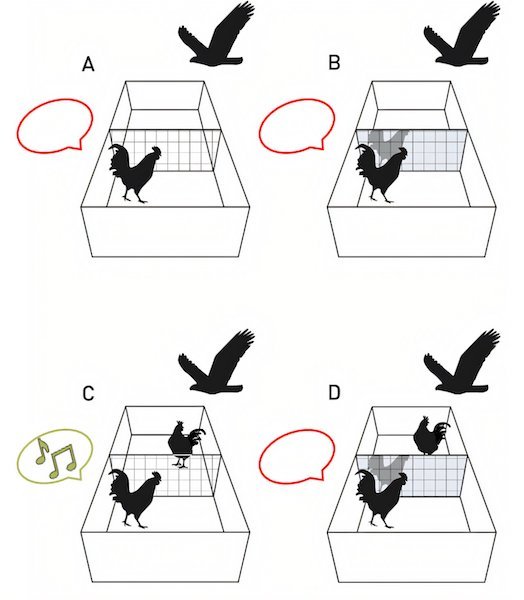 Experimental conditions of the "mirror-audience test" in roosters The tested rooster was placed in an arena divided by a transparent glass (A,C) or a mirror (B,D). Credit: Philosophical Transactions of the Royal Society B: Biological Sciences (2025).
Nov. 25, 2025
Although scientific research about consciousness has enjoyed a boom in the past two decades, one central question remains unanswered: What is the function of consciousness? Why did it evolve at all?
The answers to these questions are crucial to understanding why some species (such as our own) became conscious while others (such as oak trees) did not. Furthermore, observing the brains of birds shows that evolution can achieve similar functional solutions to realize consciousness despite different structures.
The working groups led by Professors Albert Newen and Onur Güntürkün at Ruhr University Bochum, Germany, report their findings in a current special issue of the journal Philosophical Transactions of the Royal Society B: Biological Sciences from November 13, 2025.
(more)
- CategoriesEdited | All Content | Education | Science | North America | Europe | News | News -- WNT Selected | Text | Images | Front Page Stories | Front Page News & Analysis
- Date rangeTuesday, November 25, 2025
- Last modifiedTuesday, November 25, 2025
