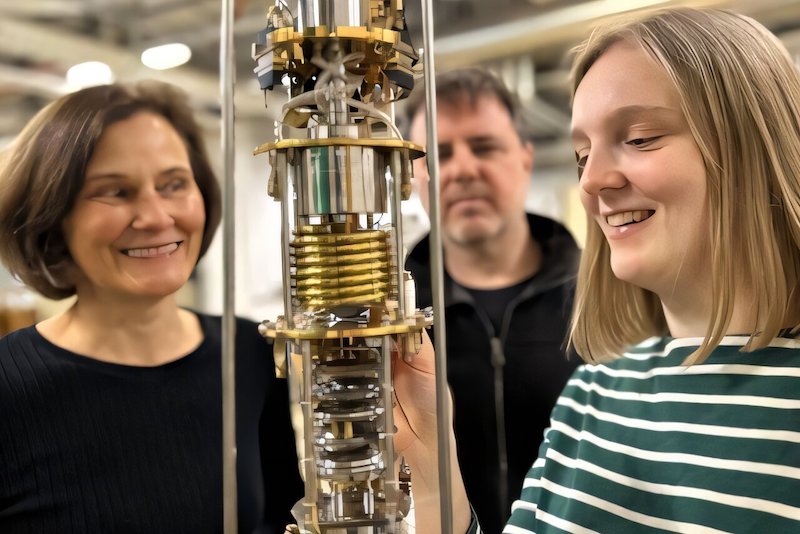
 Silke Bühler-Paschen (left), Diego Zocco and Diana Kirschbaum. Credit: TU Wien
Jan. 15, 2025
Researchers have discovered a state in a quantum material that had previously been considered impossible.
The work is published in Nature Physics.
Quantum physics tells us that particles behave like waves and, therefore, their position in space is unknown. Yet in many situations, it still works remarkably well to think of particles in a classical way -- as tiny objects that move from place to place with a certain velocity.
When physicists describe how electric current flows through metals, for example, they imagine electrons racing through the material and being accelerated or deflected by electromagnetic fields.
Even more modern approaches are based on this particle picture -- such as the concept of topological states, whose discovery was honored with the Nobel Prize in Physics in 2016. However, there are materials in which the particle picture completely breaks down (see publication below). In such cases, it no longer makes sense to think of electrons as small particles with a well-defined position or a unique velocity.
Now, a research team at TU Wien has shown that such materials can nevertheless exhibit topological properties -- even though these have so far been explained using particle-like behavior. This demonstrates that topological states are more general than previously thought: two seemingly contradictory concepts turn out to be compatible.
(MORE)

www.malaymail.com/news/world/2026/01/11/bomb-attac…

BANGKOK, Jan 11 — A series of late-night bomb attacks targeted 11 PTT petrol stations in Thailand’s southern border provinces of Narathiwat, Pattani and Yala…
www.khaama.com/at-least-eight-refugees-die-37-resc…

At least eight refugees died and 37 were rescued when their boat sank off Badmeli near Izmir, Turkish authorities said on Saturday.
katu.com/news/local/oregon-confirms-first-measles-…

Health officials in Oregon have confirmed the state's first measles cases of 2026, with two people diagnosed in Linn County.
abc11.com/post/measles-north-carolina-state-report…
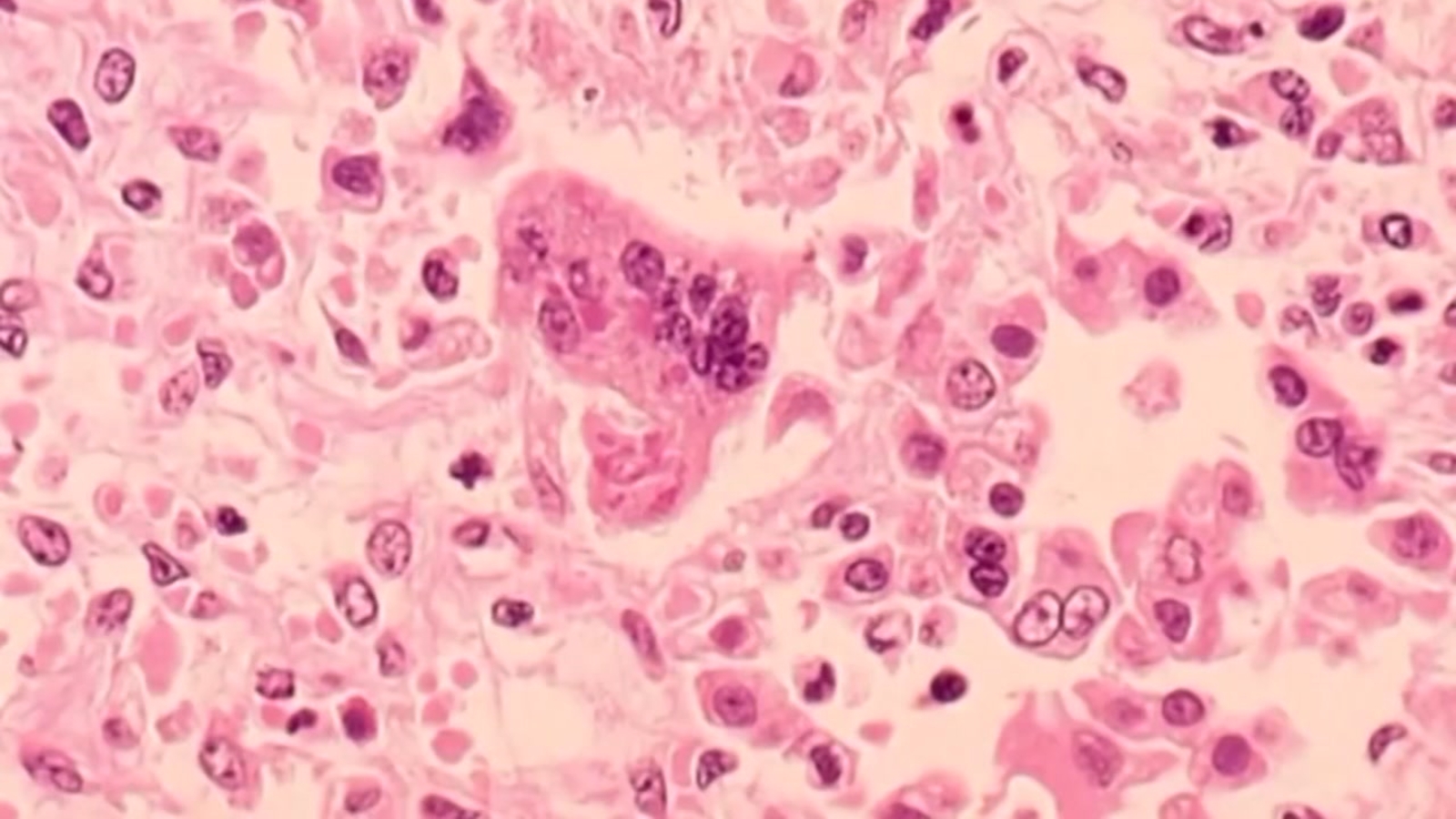
Measles in North Carolina: State reports 5th case linked to South Carolina surge