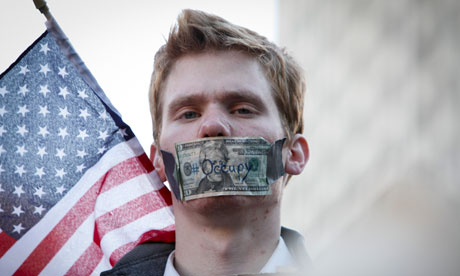
Oct. 7, 2011 (guardian.co.uk) -- The protest movement called Occupy Wall Street has struck a nerve. The demonstrators' goals may be vague but their grievances are very real. If our country is to break out of this horrendous recession and create the millions of jobs we desperately need, if we are going to create a financially-stable future, we must take a hard look at Wall Street and demand fundamental reforms. I hope the protesters provide the spark that ignites that process.
The truth is that millions of Americans lost their jobs, their homes and their life savings because of the greed, recklessness and illegal behavior of Wall Street. Even Federal Reserve Chairman Ben Bernanke agreed when I questioned him this week at a joint economic committee hearing that that there was "excessive risk-taking" by Wall Street. Bernanke also said the protesters "with some justification" hold the financial sector responsible for "getting us into this mess", and added, "I can't blame them."
The demonstrators and millions of sympathetic Americans understand that odds are stacked in Wall Street's favor because of the extraordinary economic and political clout of the big banks. Believe it or not, the country's six largest financial institutions (Bank of America, CitiGroup, JP Morgan Chase, Wells Fargo, Morgan Stanley and Goldman Sachs) now have amassed assets equal to more than 60% of our gross domestic product. The four largest banks issue two-thirds of all credit cards, half of all mortgages, and hold nearly 40% of all bank deposits. Incredibly, after we bailed out the behemoth banks that were "too big to fail", three out of the four are now even bigger than they were before the financial crisis.
Not only do these financial institutions have enormous economic clout, their wealth makes them an extremely potent political force. From 1998 through 2008, in order to achieve their goal of repealing Glass-Steagall and other financial regulations, they spent more than $5bn on lobbying and campaign contributions. They also spent hundreds of millions to water down last year's Dodd-Frank reform bill. After the law was passed, hundreds of millions more were spent to repeal provisions and weaken regulations. They never give up.