 ...and the end of civilization
James Marriott -- Substack
Sept. 19, 2025
— Neil Postman, Amusing Ourselves to Death
The age of print
It was one of the most important revolutions in modern history -- and yet no blood was spilled, no bombs were thrown and no monarch was beheaded.
Perhaps no great social transformation has ever been carried out so quietly. This one took place in armchairs, in libraries, in coffee houses and in clubs.
What happened was this: in the middle of the eighteenth century huge numbers of ordinary people began to read.
For the first couple of centuries after the invention of the printing press, reading remained largely an elite pursuit. But by the beginning of the 1700s, the expansion of education and an explosion of cheap books began to diffuse reading rapidly down through the middle classes and even into the lower ranks of society. People alive at the time understood that something momentous was going on. Suddenly it seemed that everyone was reading everywhere: men, women, children, the rich, the poor. Reading began to be described as a “fever”, an “epidemic”, a “craze”, a “madness”. As the historian Tim Blanning writes, “conservatives were appalled and progressives were delighted, that it was a habit that knew no social boundaries.”
This transformation is sometimes known as the “reading revolution”. It was an unprecedented democratisation of information; the greatest transfer of knowledge into the hands of ordinary men and women in history.
In Britain only 6,000 books were published in the first decade of the eighteenth century; in the last decade of the same century the number of new titles was in excess of 56,000. More than a million new publications appeared in German over the course of the 1700s. The historian Simon Schama has gone so far as to write that “literacy rates in 18th century France were much higher than in the late 20th century United States.”
Where readers had once read “intensively,” spending their lives reading and re-reading two or three books, the reading revolution popularised a new kind of “extensive” reading. People read everything they could get their hands on: newspapers, journals, history, philosophy, science, theology and literature. Books, pamphlets and periodicals poured off the presses.
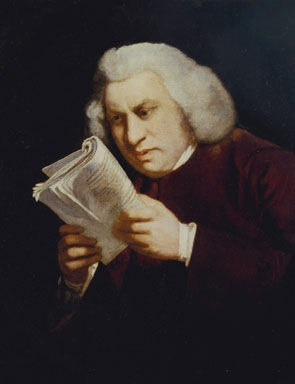 Samuel Johnson: Literary Giant of the 18th Century” @ The Huntington Library - Alain.R.Truong
It was an age of monumental works of thought and knowledge: the Encyclopédie, Samuel Johnson’s Dictionary of the English Language, Edward Gibbon’s Decline and Fall of the Roman Empire, Immanuel Kant’s Critique of Pure Reason. Radical new ideas about God, about history, about society, about politics, and even the whole purpose and meaning of life flooded through Europe.
Even more importantly print changed how people thought.
The world of print is orderly, logical and rational. In books, knowledge is classified, comprehended, connected and put in its place. Books make arguments, propose theses, develop ideas. “To engage with the written word”, the media theorist Neil Postman wrote, “means to follow a line of thought, which requires considerable powers of classifying, inference-making and reasoning.”
As Postman pointed out, it is no accident, that the growth of print culture in the eighteenth century was associated with the growing prestige of reason, hostility to superstition, the birth of capitalism, and the rapid development of science. Other historians have linked the eighteenth century explosion of literacy to the Enlightenment, the birth of human rights, the arrival of democracy and even the beginnings of the industrial revolution.
The world as we know it was forged in the reading revolution.
The counter-revolution
Now, we are living through the counter-revolution.
(more)

www.malaymail.com/news/world/2026/01/11/bomb-attac…

BANGKOK, Jan 11 — A series of late-night bomb attacks targeted 11 PTT petrol stations in Thailand’s southern border provinces of Narathiwat, Pattani and Yala…
www.khaama.com/at-least-eight-refugees-die-37-resc…

At least eight refugees died and 37 were rescued when their boat sank off Badmeli near Izmir, Turkish authorities said on Saturday.
katu.com/news/local/oregon-confirms-first-measles-…

Health officials in Oregon have confirmed the state's first measles cases of 2026, with two people diagnosed in Linn County.
abc11.com/post/measles-north-carolina-state-report…

Measles in North Carolina: State reports 5th case linked to South Carolina surge