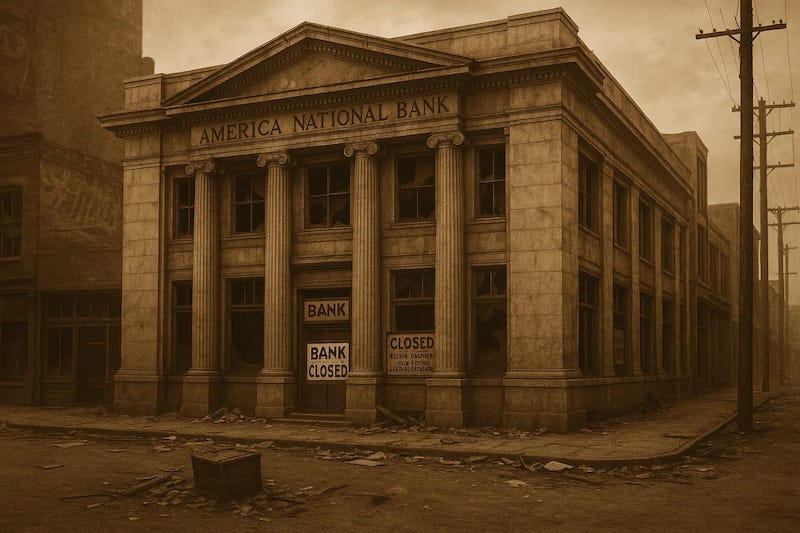
 Image: Critical Resistance
An update to the original analysis on the FDIC dismantling
Mar 30, 2025
(This is an update to the original analysis: The FDIC Is Being Dismantled—Most Won’t Realize Until It’s Too Late. If you haven’t read that piece, start here. For actionable strategies, see the accompanying guide: The Playbook for Resisting a Banking Collapse.)
When I published the original FDIC analysis in February, the dismantling of deposit protections was already underway, but still moving quietly.
It was possible, then, to dismiss the warnings as speculative or premature. Now, nearly every structural change forecasted has materialized -- on paper, in staffing, in policy, and in coordination with the Treasury.
This is no longer about early warnings. It’s about naming what is already happening while the public is still being told everything is fine. What seemed like long-term strategy just weeks ago has already begun reshaping regulatory structures in real time.
The collapse of institutional safeguards is not loud. It’s procedural. What was once a fringe blueprint is now being translated into law. This update tracks what has shifted, who is driving it, and what signals to watch for next.
These policy shifts may seem technical or distant. But the weakening of FDIC oversight and the movement toward private digital assets doesn’t just affect large banks or cryptocurrency enthusiasts. It directly impacts you.
Your savings: Deregulation is quietly transferring risk back onto depositors, meaning your personal savings and checking accounts could become less secure without clear public awareness.
Your access: Centralizing control under the Treasury means fewer checks and balances. Decisions about your money—its protection, availability, and value—are becoming less transparent and more political.
Your financial options: Rapid digitization and private-market solutions (like stablecoins and crypto) could exclude those who lack financial resources, technical literacy, or stable access to digital banking.
Consumer protections: Recent legislation dismantling restrictions on overdraft fees and penalties directly exposes everyday consumers to heightened financial vulnerability, disproportionately affecting lower-income and financially insecure households. This isn't abstract—it's a direct hit to your financial safety.
Crypto exposure: As deregulation fast-tracks cryptocurrency and digital finance, traditional banking institutions are increasingly involved in speculative activities. This creates a hidden layer of risk in seemingly "safe" banks, potentially putting your deposits in harm's way without you even knowing.
Housing instability as a leading indicator: Recent data shows that FHA-backed mortgages—which typically support first-time homebuyers or those with lower credit scores—have accounted for 90% of the recent increase in mortgage delinquencies. This sharp rise signals growing financial instability among vulnerable populations, potentially foretelling broader economic stress.
The result: financial uncertainty isn’t just theoretical -- it’s becoming structural. Understanding this is essential not just to protect yourself, but also to prepare for what may come next.
(more)

www.malaymail.com/news/world/2026/01/11/bomb-attac…

BANGKOK, Jan 11 — A series of late-night bomb attacks targeted 11 PTT petrol stations in Thailand’s southern border provinces of Narathiwat, Pattani and Yala…
www.khaama.com/at-least-eight-refugees-die-37-resc…

At least eight refugees died and 37 were rescued when their boat sank off Badmeli near Izmir, Turkish authorities said on Saturday.
katu.com/news/local/oregon-confirms-first-measles-…

Health officials in Oregon have confirmed the state's first measles cases of 2026, with two people diagnosed in Linn County.
abc11.com/post/measles-north-carolina-state-report…

Measles in North Carolina: State reports 5th case linked to South Carolina surge