Artificial intelligence finds 56 new gravitational lens candidates | Carlo Enrico Petrillo
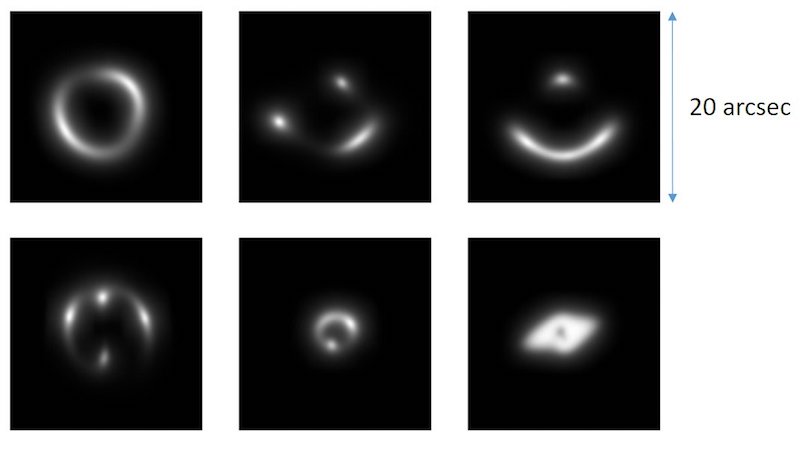 This picture shows a sample of the handmade photos of gravitational lenses that the astronomers used to train their neural network. Credit: Enrico Petrillo, University of Groningen
Oct. 23, 2017 (Phys.org) -- A group of astronomers has developed a method that uses artificial intelligence to find gravitational lenses in enormous piles of observations.
The method is based on the same AI algorithm that Google, Facebook and Tesla have been using in recent years. Researchers from the universities of Groningen, Naples and Bonn published their method and 56 new gravitational lens candidates in the November issue of Monthly Notices of the Royal Astronomical Society.
When a galaxy is hidden behind another galaxy, we can sometimes see the hidden one around the front system. This phenomenon is called a gravitational lens because it emerges from Einstein's general relativity theory which says that mass can bend light. Astronomers search for gravitational lenses because they help in the research of dark matter.
The hunt for gravitational lenses is painstaking. Astronomers have to sort thousands of images. They are assisted by enthusiastic volunteers around the world. So far, the search was more or less in line with the availability of new images. But thanks to new observations with special telescopes that reflect large sections of the sky, millions of images are added. Humans cannot keep up with that pace.
(more)
- CategoriesEdited | Front Page Stories | All Content | Education | Science | North America | Europe | Space | News | News -- WNT Selected | Slider
- Date rangeMonday, October 23, 2017
- Last modifiedSunday, October 29, 2017
